In this article
- 1 How to Care for Tacca (Bat Flower) – Expert tips for thriving plants
- 1.1 Tacca care: 10 expert tips for growing it successfully
- 1.2 Tacca care tips
- 1.2.1 Light requirements for Tacca
- 1.2.2 Watering
- 1.2.3 Nutrition
- 1.2.4 Temperature & humidity
- 1.2.5 Soil & repotting
- 1.3 Propagating Tacca
- 1.4 Most common pests on Tacca
- 1.5 Is Tacca poisonous for your pets or children?
- 1.6 Buy your new Tacca online at PLNTS.com
How to Care for Tacca (Bat Flower) – Expert tips for thriving plants
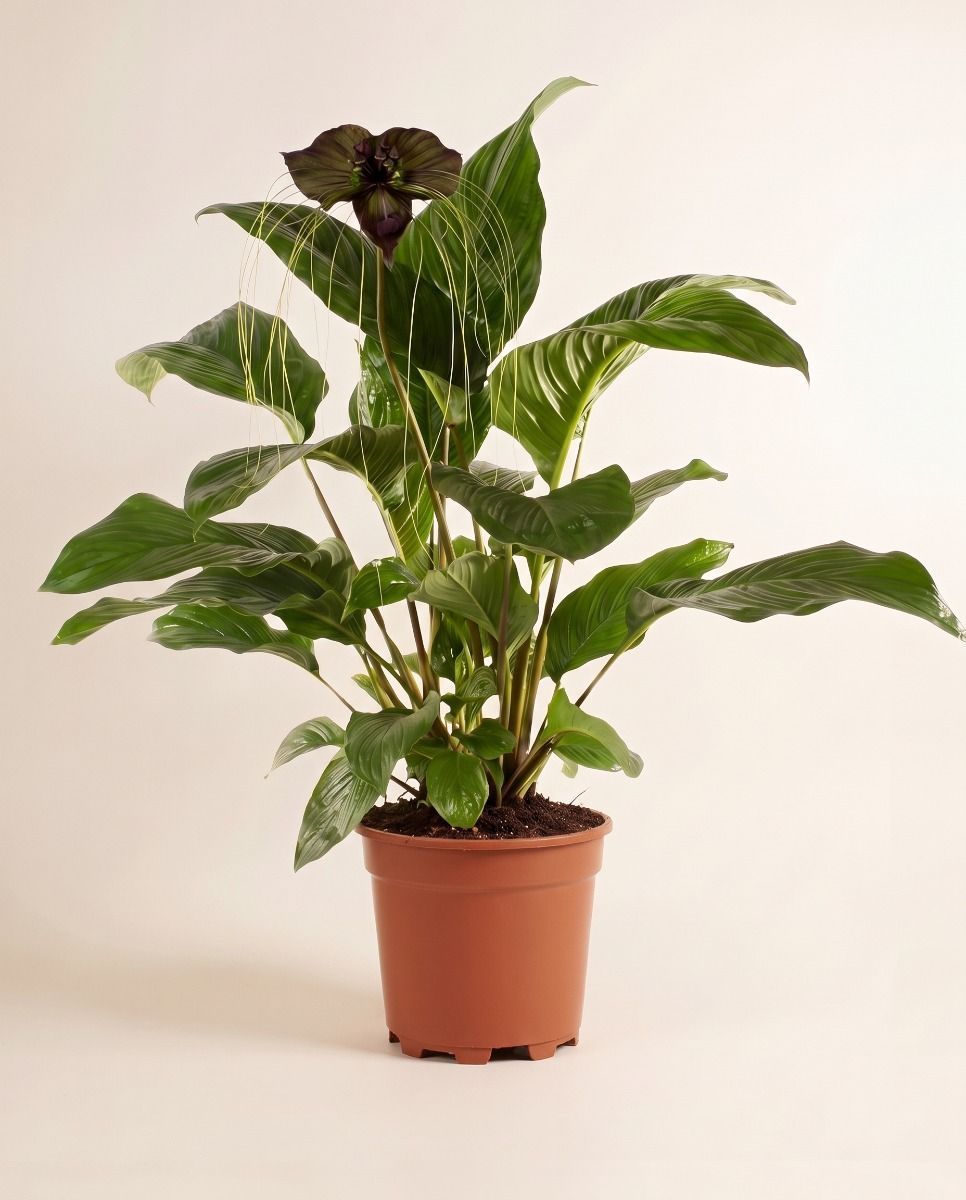
Tacca, better known as the Bat Flower, is one of the most unusual flowering houseplants you can grow. Its dramatic, dark purple to almost black flowers look like a bat in flight, complete with long trailing "whiskers" that can reach up to 30 cm. The best-known species is Tacca chantrieri (Black Bat Flower), while Tacca integrifolia is the White Bat Flower with large white bracts.
Tacca grows naturally in the shaded, humid understory of tropical forests in Southeast Asia. Bring those conditions into your home – warmth, high humidity and filtered light – and this botanical curiosity will reward you with its spectacular blooms.
Tacca care: 10 expert tips for growing it successfully
- Place your Tacca in bright, indirect light – never in direct sun.
- Keep the soil evenly moist, but never soggy.
- Use rainwater or water at room temperature.
- Aim for high humidity of at least 60%.
- Keep temperatures between 18–30°C and never below 15°C.
- Avoid cold draughts and spots near radiators.
- Feed once a month in spring and summer.
- Use an airy, well-draining soil mix.
- Give the plant a rest period in winter with less water.
- Repot in spring, only when the roots fill the pot.
Tacca care tips
Light requirements for Tacca
In nature, Tacca grows beneath the forest canopy, so it prefers bright but filtered light. A spot a few metres from an east- or west-facing window is ideal. Direct sunlight scorches the large leaves quickly.
Expert tip! Brown, dry patches on the leaves usually mean too much sun. Pale leaves and no flowers? Then your Tacca needs a little more light.
Watering
Tacca likes soil that stays slightly moist during the growing season. Water as soon as the top layer of soil feels dry, and always let excess water drain away. Wet feet lead to root rot in the fleshy rhizome.
In autumn and winter the plant slows down. Water less, and let the top few centimetres of soil dry out between waterings.
Expert tip! Use lukewarm rainwater or filtered water. Cold tap water can shock this tropical plant.
Nutrition
During spring and summer, give your Tacca liquid houseplant food once a month. This supports both leaf growth and flowering. Stop feeding in autumn and winter.
Temperature & humidity
Tacca is a true tropical plant and thrives at temperatures between 18–30°C. Below 15°C, growth stops and the plant can be damaged.
High humidity is the key to success. Place the plant on a tray with water and pebbles, use a humidifier or group it with other plants. A bright bathroom is often a perfect spot.
Expert tip! Dry, crispy leaf edges are a sign that the air is too dry.
Soil & repotting
Choose an airy, well-draining mix, for example houseplant soil combined with orchid bark and perlite. This keeps moisture around the roots without the soil becoming waterlogged.
Repot in spring, only when the roots fill the pot. Tacca flowers best when it is slightly pot-bound.
Propagating Tacca
Tacca can be propagated by dividing the rhizome when repotting.
Here's how to do it:
- Carefully remove the plant from its pot in spring.
- Gently loosen the soil around the rhizome.
- Cut the rhizome into sections with a clean, sharp knife, making sure each section has at least one growth point and some roots.
- Let the cut surfaces dry for a day.
- Plant the sections in fresh, airy soil and keep them warm and slightly moist.
Propagating from seed is also possible, but it requires patience and constant warmth.
Most common pests on Tacca
Tacca can be bothered by spider mites and mealybugs, especially when the air is dry. Check the undersides of the leaves regularly. Higher humidity is the best way to prevent spider mites.
Is Tacca poisonous for your pets or children?
The rhizomes of some Tacca species are toxic when eaten raw. Place your Bat Flower out of reach of pets and children to be on the safe side.
Buy your new Tacca online at PLNTS.com
Looking for a plant that is guaranteed to spark conversation? At PLNTS.com you can buy Tacca chantrieri online and add a true botanical curiosity to your collection.
With its bat-shaped flowers and long whiskers, the Bat Flower is a must-have for every lover of rare and unusual plants.