In this article
- 1 How to Care for Sarracenia (Pitcher Plant) – Expert tips for thriving plants
- 1.1 Sarracenia care: 10 expert tips for growing it successfully
- 1.2 Sarracenia care tips
- 1.2.1 Light requirements for Sarracenia
- 1.2.2 Watering
- 1.2.3 Nutrition
- 1.2.4 Temperature & humidity
- 1.2.5 Soil & repotting
- 1.3 Propagating Sarracenia
- 1.4 Most common pests on Sarracenia
- 1.5 Is Sarracenia poisonous for your pets or children?
- 1.6 Buy your new Sarracenia online at PLNTS.com
How to Care for Sarracenia (Pitcher Plant) – Expert tips for thriving plants
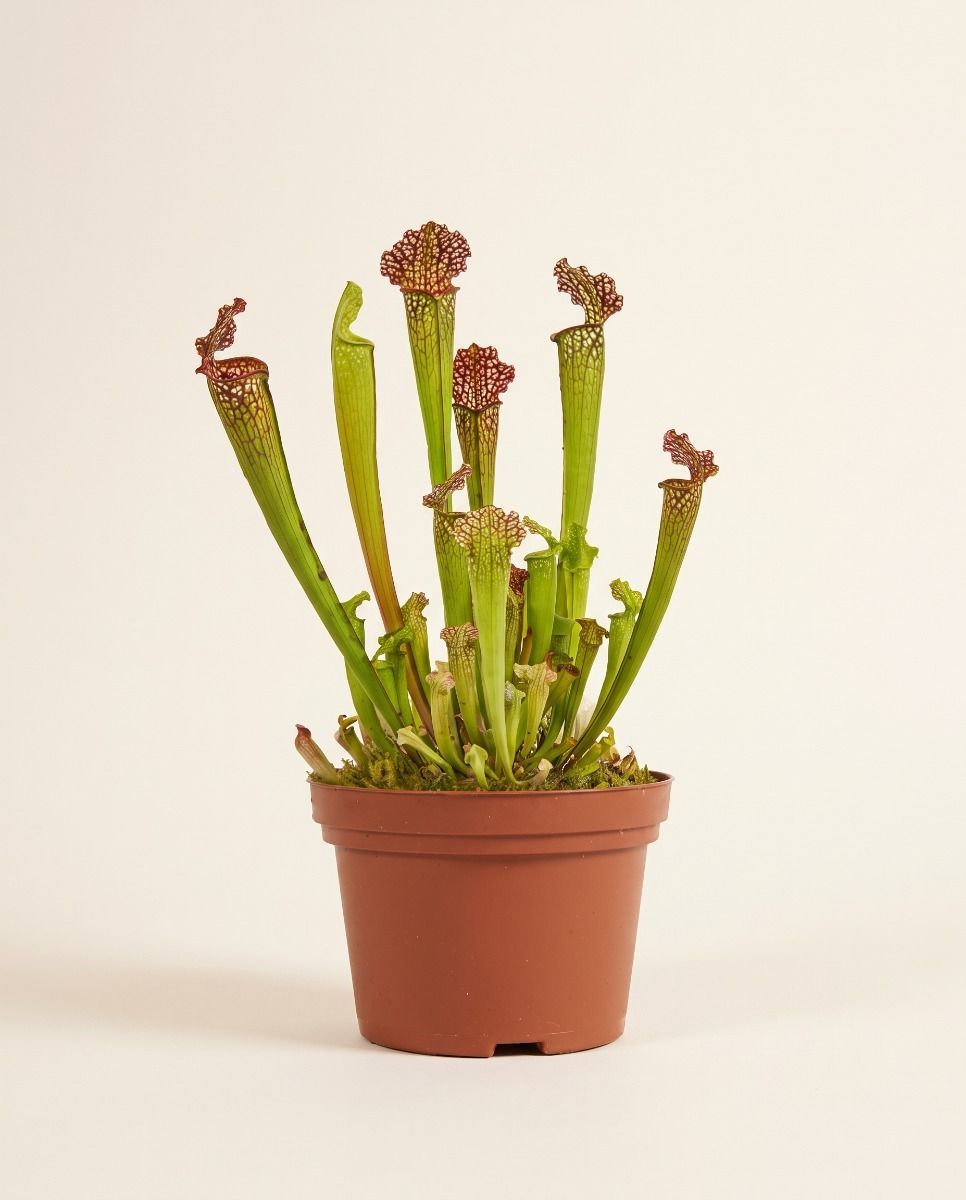
Sarracenia, better known as the Pitcher Plant or Trumpet Pitcher, is a carnivorous plant that actively hunts for its food. Its leaves form tall, hooded trumpets, often green with deep red veining. Nectar around the opening lures insects inside, where they slide down and are digested. Hybrids such as Sarracenia 'Juthatip Soper' have wide-mouthed pitchers that colour up dramatically as they mature.
Sarracenia grows naturally in sunny bogs and wet meadows in North America. Unlike the tropical pitcher plant (Nepenthes), which hangs its pitchers from tendrils, Sarracenia grows its pitchers straight up from the ground. And unlike most houseplants, it needs full sun, soft water, wet feet and a cool winter rest.
Sarracenia care: 10 expert tips for growing it successfully
- Give your Sarracenia as much direct sun as possible.
- Only use rainwater, distilled or demineralised water.
- Keep the pot in a tray with about 2 cm of water during spring and summer.
- Never fertilise the soil.
- Use a nutrient-poor carnivorous plant mix.
- Let it spend summer outside on a sunny balcony or terrace.
- Give it a cool winter rest at 5–10°C.
- Water much less during the winter rest.
- Cut off dead pitchers in early spring.
- Repot every two years in early spring.
Sarracenia care tips
Light requirements for Sarracenia
Sarracenia needs lots of direct sun to grow strong, colourful pitchers. A south-facing windowsill is the minimum indoors. From spring to autumn, a sunny balcony or terrace is even better.
Expert tip! Weak, floppy pitchers with little colour almost always mean the plant needs more sun.
Watering
Sarracenia is a bog plant and likes wet feet. In spring and summer, keep the pot in a tray with about 2 cm of water. Always use rainwater, distilled or demineralised water: the minerals in tap water slowly damage the roots.
Expert tip! Never let the soil dry out in the growing season. In winter, keep it just moist instead of standing in water.
Nutrition
Do not fertilise Sarracenia. It gets its nutrients from the insects it catches, and fertiliser in the soil burns the roots. Indoors, the plant survives fine without insects as long as it gets enough sun.
Temperature & humidity
In the growing season, Sarracenia does well in normal to warm temperatures. In winter it needs a rest period of about three to four months at 5–10°C, for example in a cool, bright room or a frost-free shed with a window. Without this rest, the plant weakens over time.
Expert tip! Pitchers dying back in autumn are completely normal. New pitchers appear in spring.
Soil & repotting
Use a nutrient-poor carnivorous plant mix, for example sphagnum moss with perlite. Never use regular potting soil. Repot every two years in early spring, before new growth starts.
Propagating Sarracenia
Sarracenia can be propagated by dividing the rhizome.
Here's how to do it:
- Remove the plant from its pot in early spring.
- Look for separate growth points along the rhizome.
- Cut the rhizome into pieces with a clean knife, each with roots and at least one growth point.
- Plant the pieces in fresh carnivorous plant mix.
- Place them in a tray of rainwater in a sunny spot.
Most common pests on Sarracenia
Although Sarracenia catches insects, it can still be bothered by aphids and mealybugs, especially on young pitchers. Rinse them off with rainwater and avoid chemical sprays, which can damage the plant.
Is Sarracenia poisonous for your pets or children?
Sarracenia is considered non-toxic to people and pets.
Buy your new Sarracenia online at PLNTS.com
Looking for a plant that is anything but passive? At PLNTS.com you can buy Sarracenia Juthatip Soper online and add a real hunter to your collection.
For more carnivorous plants, also read our care tips for the Venus Flytrap.